Kite Size Calculator: How to Pick the Right Kite from the Forecast
How to read wind, gust, and rider weight off the forecast and pick the right kite size — with a clean chart for twin-tip riders, foilers, and gusty days.
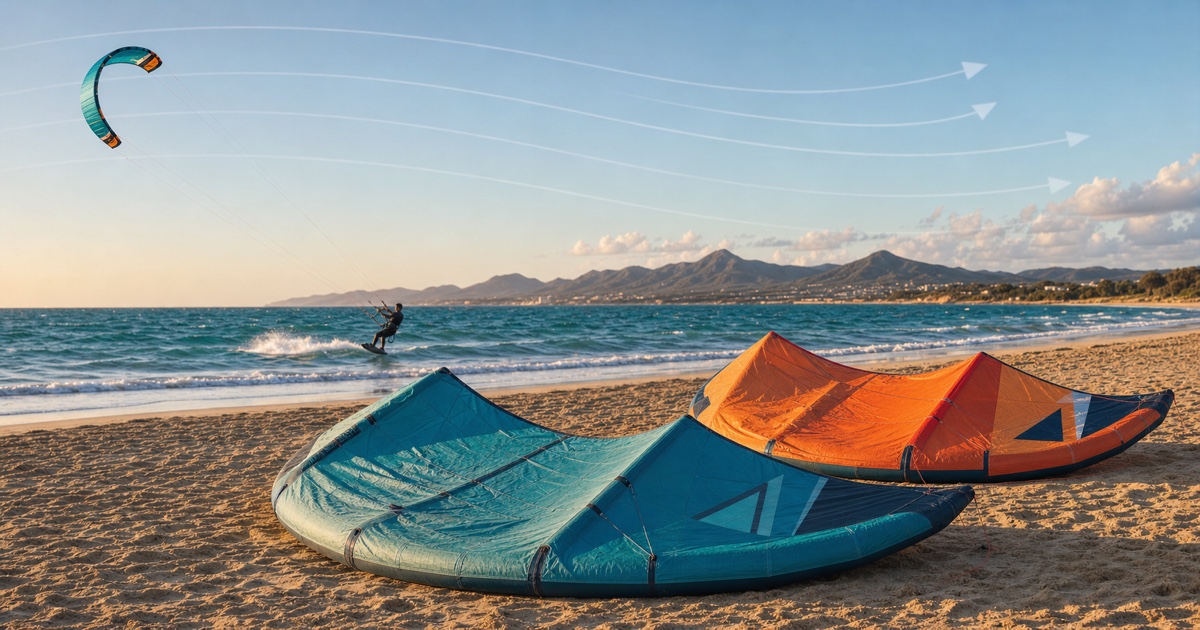
You open the forecast: 18 knots average, gusting 27, and you’ve got a 9 m, a 12 m, and a 7 m sitting in the bag. Which one goes on the beach? Pick wrong and you spend the session schlogging (plowing through the water without enough power to plane) or hanging on for dear life. Pick right and you forget about the kite ten minutes in — exactly what you want.
Picking a kite size isn’t magic. It comes down to four things: average wind, gust strength, your weight, and your skill level. This guide gives you a clean chart, the rules around it, and how to read the forecast so you walk to the beach already sure of which kite is on the bar.
What kite size actually depends on
Three inputs decide it:
- Average wind speed — measured in knots (kt). The forecast’s hourly average over your sailing window is the starting point.
- Rider weight — heavier riders need more wind or more kite to get going. Roughly, every 10 kg up means 1–2 m² more kite at the same wind.
- Gust factor — the ratio between average and peak. A 15 kt average gusting to 18 is steady. A 15 kt average gusting to 28 is a different sport.
- Skill level — a beginner riding overpowered loses control fast. An advanced rider sheets out, edges harder, and uses the depower they have. The same forecast calls for different kites depending on which side of that line you’re on.
The matrix below is the baseline every rider works from. The skill adjustments come right after.
The wind + weight matrix — twin-tip
These are typical ranges for an intermediate rider on a modern freeride twin-tip, aiming for a comfortable, planing session — not maxed out, not underpowered.
| Rider weight | 12 kt | 15 kt | 18 kt | 22 kt | 28 kt | 35 kt |
|---|---|---|---|---|---|---|
| 55 kg | 12 m | 10 m | 8 m | 7 m | 5 m | 4 m |
| 65 kg | 13 m | 11 m | 9 m | 8 m | 6 m | 5 m |
| 75 kg | 14 m | 12 m | 10 m | 9 m | 7 m | 5 m |
| 85 kg | — | 13 m | 11 m | 10 m | 8 m | 6 m |
| 95 kg | — | 14 m | 12 m | 11 m | 9 m | 7 m |
Read it as: for your weight at this average wind, that’s the kite that lands you in the middle of its range — depower available if it builds, sheet-in capacity if it lulls.
A few rules of thumb fall out of the chart:
- Each 5 kt up = roughly 1–2 m² down for the same rider.
- Each 10 kg up = roughly 1–2 m² up at the same wind.
- Under 12 kt is twin-tip marginal territory — bigger kites, lighter riders, more board volume. Below ~10 kt, foil is the right tool.
- Skill adjustment — beginners stick to the chart in light wind and go smaller in strong wind (over 18 kt) for safety. Advanced riders often go the other way: 1 m² bigger than the chart and use the kite’s depower to manage the extra power — more grunt for jumps, more low-end in lulls, sheeted out in gusts. Beginners should never size up in strong wind.
Why gusts matter more than averages
Modern kites have a depower range of roughly 1.5×. A 10 m that’s powered at 18 kt is still controllable around 25–27 kt — but the gust-to-average ratio decides whether the session is fun or scary.
A simple gust rule:
- Gust factor under 1.3 (gusts within 30% of average) — size to the average. Forecast says 18 kt gusting 22, ride the size for 18.
- Gust factor 1.3 to 1.5 — size for the gust, not the average. Forecast says 18 kt gusting 27, ride the size for 22.
- Gust factor over 1.5 — pick the smaller kite and be cautious. Forecast says 15 kt gusting 25, that’s an unstable wind window — gusty offshore, a collapsing thermal, or air spilling off terrain.
Gusts also tell you what kind of wind you’re getting. Clean sea breeze: gust factor near 1.1. Post-frontal westerlies: 1.3–1.4. Gusty thermal valley wind or the lee of an island: 1.5+. The forecast number is half the story; the spread is the other half.
Foil vs twin-tip — different math
A foil board generates lift hydrodynamically, so it needs far less drag-driving wind to get going. A 12 m kite that schlogs on a twin-tip in 10 kt will fly a foil upwind comfortably at the same wind.
Rough adjustment versus the twin-tip chart — pick whichever frame feels easier:
- Same kite, less wind — a foil rides ~4–6 kt lighter than a twin-tip on the same kite. The 12 m that needs 12 kt on a TT works from ~7–8 kt on a foil.
- Same wind, smaller kite — at the same wind, drop ~2 m² versus the TT chart. A 75 kg rider in 18 kt rides a 10 m on TT and an 8 m on foil. In 14 kt the same rider goes 12 m on TT, 10 m on foil.
Foilers rarely go above 12 m, because once the wind is steady over 14 kt you’re flying small kites and don’t need the low end of a big one. The most-used quiver for a 70 kg foiler is roughly 7 m, 9 m, 12 m — covering 8 kt to 25 kt comfortably. Front-wing area shifts the math too: a bigger, lower-aspect wing lifts earlier, so you can drop another 1 m² of kite; a smaller race wing wants 1 m² more.
Two foil-specific traps:
- Gusts feel bigger on foil. You’re moving faster relative to the wind, so apparent-wind spikes are sharper. Treat the gust column as one notch firmer than the chart says.
- Heavier riders need more kite, not much more wind. A 70 kg rider gets a 12 m foil session going around 8 kt; a 90 kg rider on the same 12 m wants ~9–10 kt — not a big jump. The bigger lever for heavier riders is sizing up to a 14–15 m light-wind kite, which buys back the bottom end at the cost of pumping the kite harder in lulls.
Reading the forecast like a sizing tool — checklist
Before you load the car, run through this:
- What’s the average wind in your sailing window — the peak hour, not dawn?
- What’s the gust factor (peak / average) over that window?
- What’s the wind direction relative to the spot? Cross-on at a clean beach reads at face value; offshore in the lee of a hill reads gustier than the number.
- Is it a sea-breeze ramp day? If so, the afternoon peak is what matters — and high-resolution models like AROME and ICON read it better than GFS. (See Types of Wind, GFS vs ICON, and Sea Breeze 101.)
- Are the models agreeing or disagreeing? Tight spread = trust the number. Wide spread = pack one size up and one size down.
If you can answer those five, you have your kite. If three of them are unclear, take the smaller kite and a board with more volume — being underpowered on a session is annoying, being overpowered with no depower left is dangerous.
Where sizing bites the hardest
Some spots punish a wrong call more than others.
- Tarifa, Spain — Levante days are gusty (factor 1.3–1.5) and accelerate through the strait by afternoon. Walk to the beach at 22 kt with the size for 25, not the size for 22.
- Hyères / Almanarre, France — clean afternoon sea breeze, gust factor often near 1.1. The number you see is the number you ride — match the matrix exactly.
- Dakhla, Morocco — steady trades, 15–25 kt for weeks. Two kites cover most riders: a 9 m and a 12 m at 75 kg.
- Cape Town / Big Bay, South Africa — south-easter days routinely 25–35 kt with strong gusts. The chart’s right-hand columns are where you live.
Frequently Asked Questions
What kite size do I need for 20 knots?
For an average 75 kg rider on a twin-tip in 20 kt, a 9 m is the sweet spot. A lighter 60 kg rider goes to 7–8 m, a heavier 90 kg rider to 11 m. Drop a size if gusts are above 26 kt.
How many kites do I really need?
Two kites cover most of the year for most riders. A 9 m + 12 m at 75 kg handles roughly 14–26 kt of usable twin-tip wind — which is most riding days at most spots. (A 12 m at 12 kt for a 75 kg rider is a schlog, not a session — that’s where a 14 m or a foil takes over.) A third kite — 7 m for high wind or 14 m for light wind — extends the range at the edges.
Should a beginner ride a smaller or bigger kite?
Neither blindly — and never bigger in strong wind. A beginner needs enough power to get up and going, but no depower or recovery skills yet, so being overpowered is the dangerous direction. Lofting from a too-big kite in 25 kt is the most common serious-injury scenario. The safe rule:
- In light to moderate wind (under ~16 kt) — pick the chart size, or at most 1 m² up if the wind is steady and clean.
- In stronger wind (18 kt+) — go one size smaller than the chart, even if it means schlogging the first runs. Smaller kite + clean conditions beats bigger kite + gusts every time.
- Skip the session if the gust factor is over 1.4 or the wind is offshore — those aren’t beginner conditions, regardless of kite size.
Does kite type change the size I pick?
Yes, but less than you’d think. Modern bow and hybrid kites sit in a similar depower range. Old-school C-kites have less depower and want about 1 m² less than the chart at the same wind. Single-strut light-wind kites can stretch the low end by 2–3 kt.
How does forecast model spread show up in sizing?
Most apps show average wind and a separate gust line — that ratio is your gust factor. Some tools also show model spread: when GFS, ICON, and AROME disagree, that’s a forecast-level “gust” — a sign the atmosphere is unstable, and that the actual wind could land anywhere across the spread. Pack accordingly.
How Wavind helps
Most apps give you one number from one model. Wavind shows GFS, ICON, and AROME side by side, and the spread between them is exactly what tells you whether to pack one size or two. Tight spread? The matrix is reliable. Wide spread? Bring the next size up and the next size down — the wind hasn’t decided yet.
We also compute a session score for every forecast hour, folding average wind, gust factor, direction quality, and model agreement into one number. If a day scores 8/10 with low gust factor, you’re picking straight off the chart. If it scores 6/10 with wide model spread, you’re packing the bigger quiver and watching the morning runs before committing to a size.
Put this into practice
Open the live wind, wave, and tide forecast for each spot in Wavind.
- El Balneario (Tarifa) Spain Forecast
- Sotavento Lagoon (Fuerteventura) Spain Forecast
- Jericoacoara Brazil Forecast
Browse more spots: Spain spots Brazil spots