Right of Way on the Water: Kite, Wing, and Windsurf Etiquette
The shared right-of-way rules every kitesurfer, wing foiler, and windsurfer should follow — starboard tack, leeward priority, launch zones, and wave drop-ins.
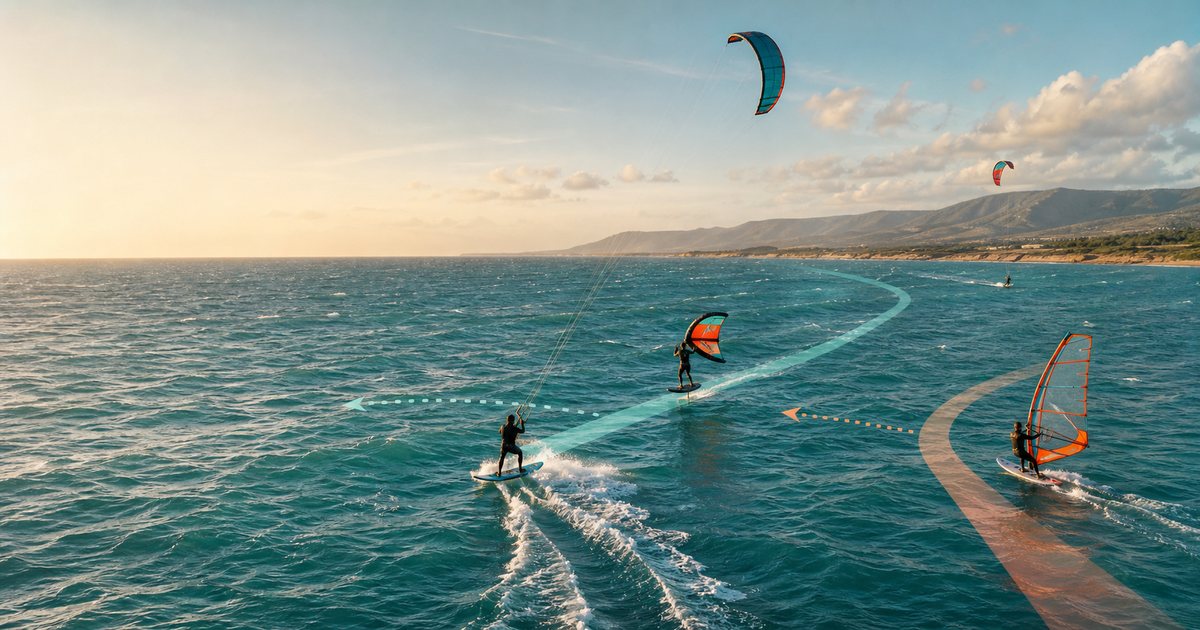
It’s 22 knots at the local beach, the forecast actually landed, and three rigs are pumping up next to your car. You walk down with a 9 m and a fresh wing rider crosses your line on a beam reach, kite at 11 o’clock, going wide-eyed past someone landing. Nobody crashes. Everyone is annoyed. That’s an etiquette problem, not a wind problem.
Crowded spots get safer the more riders share the same code — and that code is mostly the same whether you’re on a kite, a wing, a windsurf board, or a foil. This post is the short version a newer rider can read once and use on every session: who yields to whom, how to launch and land without becoming a hazard, and the unwritten beach rules every sail discipline already follows.
The shared right-of-way code
The rules that govern sail traffic on the water come from the International Regulations for Preventing Collisions at Sea (COLREGS) and the Racing Rules of Sailing (RRS). They apply equally to a kite, a wing, and a windsurfer, and you can collapse them into the shared right-of-way code — five lines:
| Situation | Who yields | Mnemonic |
|---|---|---|
| Opposite tacks | Port tack yields to starboard tack | “Right hand forward = right of way” |
| Same tack, different lanes | Windward yields to leeward | “Upwind rider gives way” |
| Overtaking | The faster rider behind always keeps clear | “If you’re catching them, you yield” |
| Launching vs returning | Inbound rider yields to the rider entering the water | “Beach side wins” |
| In the waves | Rider closest to the peak owns the wave | “First up, first right” |
A rider on starboard tack has the wind coming over their right side — right hand forward on the bar or boom. If you’re on port tack and you see a starboard-tack rider on a collision course, you bear away behind them or head up clearly in front. Don’t gamble that they’ll see you.
“Windward yields to leeward” is the most-broken rule on a busy beach. If two riders are heading the same direction and one is upwind of the other, the upwind rider holds a higher position and is expected to keep clear — change course, slow down, or pass behind.
The “launching vs returning” rule surprises most beginners. The rider coming back to shore can always loop out for another tack; the rider trying to leave the beach is the one boxed in by sand, rocks, and gear. So the inbound rider gives way and the launching rider gets the lane.
Kite-specific: when lines change the math
Kite lines are 20–25 m long. That changes every encounter, because two riders crossing on a beam reach can collide through their lines even when their boards pass 30 m apart. The kite-only rule everyone learns on day one fixes this:
- Upwind rider — kite up at 12 o’clock.
- Downwind rider — kite down near the water.
The upwind kite lifts its lines above the downwind kite, and you pass cleanly. Get it wrong and you tangle two kites at 22 kt, which is the fastest way to lose gear and write off the session for both riders.
A few extras that come straight from line length:
- Never ride directly behind a rider on the same tack — you’re on top of their wind window and one gust can drop them on your kite.
- Stay 50 m off any rider that’s body-dragging upwind or trying to relaunch — they can’t dodge you.
- Don’t jump within ~50 m downwind of another rider. Your lines sweep through a wide arc and the kite can end up where you didn’t plan.
- Inbound rider — keep the kite low and clearly off zenith as you approach shore. A kite parked at 12 o’clock in a gust is the textbook lofting setup; 10–11 or 1–2 o’clock keeps it visible without putting it in the danger zone.
Wings and windsurfers: same rules, different shape
A wing rider has no fixed lines, which removes the “kite up / kite down” choreography — but the right-of-way code above doesn’t change. Starboard still wins. Leeward still wins. The wing’s advantage is that you can dump power instantly by feathering the handle; the responsibility that comes with it is that bystanders assume you can stop, so you actually have to.
Windsurfers add speed. A planing slalom board does 25–30 kt, which means a port-tack windsurfer crossing a starboard-tack rider has roughly two seconds to react. Two practical consequences:
- Look upwind before every turn. A windsurfer coming down the line on starboard can cover 30 m while you finish a jibe.
- Don’t park in a slalom lane. On spots like Hyères or Leucate the fast lane runs parallel to the beach 50–150 m out. Cross it perpendicular and quickly, never lounge in it.
Mixed-discipline lineups need one more habit: assume the other craft is less manoeuvrable than yours. Kites turn slowly off the wind. Windsurfers can’t bear away under a kite’s lines. Wings can stop fast but can’t accelerate out of a bad situation. When in doubt, you are the one who yields.
Launching, landing, and the beach choreography
Most accidents happen within 30 m of the waterline, not out on the water. The rules:
- Look upwind and downwind before you pull the kite up. A launching kite needs a 50 m downwind buffer — that’s roughly two line lengths — clear of people, dogs, towels, and other rigs.
- Use a launch assistant and agree on a hand signal before you lift. A thumbs-up means “send it”; anything else means wait.
- Walk downwind of other rigging riders, never upwind. If your kite drops on someone else’s lines you’ve ruined their session and possibly their gear.
- Land where you launched — not in front of the swim zone. Approach slowly with the kite low and off zenith, and signal another rider for a catch by tapping your head. Hand the kite over before bringing it down — never park at 12 in the launch area.
- Never self-land a kite in crowds. If nobody is free to catch, ride down the beach until you find space and self-land where you can’t crush anyone.
- Wings: deflate or fold downwind of other riders. A loose wing rolls fast and tangles a kite line in seconds.
- Windsurfers: rig downwind of kites for the same reason. A mast in a line is an expensive afternoon.
The general principle: the beach is shared, and your gear has a downwind footprint two to three times bigger than you think.
In the waves
Wave priority rules predate kiting and wing foiling — they come from surfing — and they apply the same way:
- The rider closest to the peak owns the wave. Everyone else gets off.
- A drop-in — taking off on a wave someone else is already riding — is the universal sin in any wave lineup, kite or not.
- Paddling, kiting, or winging back out, go wide around the break, not through it. You don’t want to be in the impact zone when a wave breaks on a riding peer.
- Don’t ride waves at a swim beach. If there are swimmers in your impact zone, the spot is closed for waves that day.
Kites and wings have an advantage over surfers — you can pick a wave further out — and you should use that to yield more often, not less. The local with the longboard who has been there 20 years has priority. Earn the line by giving way for a session or two before you take one.
Foilers — the extra duty of care
A foil mast is 60–90 cm of carbon below the board. In a collision it cuts, in a fall it spears the rider on top, and in shallow water it stops the board cold. Whether you’re on a kite foil, wing foil, or windsurf foil, you owe the lineup three extra things:
- Wear a helmet and an impact vest. This is for your own head — foil falls go vertical fast.
- Hold the 50 m swimmer buffer, and add extra room for surfers and downed riders. The foil’s arc on a flying fall is unpredictable and a mast strike cuts deep.
- Learn in empty water. A first-week wing foiler who can’t bear away on command does not belong in a crowded slalom lane.
If you’re on a fin and a foiler crosses you upwind, give them more room than the rules technically require. They’re faster than they look and the consequence of contact is worse.
Pre-session etiquette checklist
Run this in the parking lot, before you rig:
- Where is the launch zone, where is the swim zone, and where is the wave lineup?
- Which tack is the prevailing one — and which side am I on coming back?
- Are there foilers out? Where?
- Is there a slalom lane I shouldn’t park in?
- Who’s the most experienced local on the beach, and what are they doing?
- Do I have a self-landing plan if no catcher is available?
If five of those six have an answer before you pump up, you’re already ahead of half the beach.
Frequently Asked Questions
What does “starboard tack” mean on a kite?
The wind is coming from your right side — your right hand is forward on the bar and the kite is launched to your right. A starboard-tack rider has right of way over a port-tack rider when their paths cross. The same definition applies on a wing, a windsurf board, and a sailboat.
Why does the upwind kite go up and the downwind kite go down?
Kite lines are 20–25 m long. When two kites pass on opposite tacks, the upwind kite at 12 o’clock lifts its lines above the downwind kite at 3 or 9 o’clock, so the lines don’t tangle. Reverse it and you’ll catch lines mid-pass.
Do these rules apply to wing foiling?
Yes — wings follow the same right-of-way code as kites and windsurfers. Starboard tack, leeward priority, and the overtaking rule all carry over. The only kite-specific rule that doesn’t apply is “kite up / kite down” because wings have no lines.
How far should I stay from swimmers?
The widely taught standard is two kite-line lengths — roughly 50 m — clear of any swimmer, diver, or paddler. Kite foilers follow the same number because the lines, not the foil, are the longest hazard. Wing and windsurf foilers don’t have lines, but the mast is a serious cutting hazard on a fall, so give swimmers at least a couple of board lengths and slow right down when you can’t. If a swim zone is marked on the beach, treat its boundary as sacred regardless of the rule. Local regulations in places like France and Italy often add a 100 m no-jump buffer near the shore on top of the swimmer rule.
Who has right of way between a kitesurfer and a windsurfer?
The same rules apply to both — whichever is on starboard tack has priority. There’s no “kite over windsurf” or “windsurf over kite” rule. In practice the windsurfer is usually faster and the kite is usually less manoeuvrable, so both should yield earlier than they think.
What do I do if someone drops in on me in the waves?
Pull off and call it out calmly back on the beach. Escalating on the water risks gear, your body, and the local goodwill you need to keep riding the spot. Repeat offenders sort themselves out — the lineup notices.
How Wavind helps
Most apps tell you whether the wind is on. Wavind also tells you when everyone else is going to think so. The session score blends wind, tide, and a crowd-likelihood signal pulled from spot history, so when GFS and ICON agree on a clean afternoon at your home break, you can see at a glance whether you’re walking into an empty Tuesday or a packed Saturday lineup — and plan launches around it.
For mixed-discipline beaches, per-spot rider notes let you tag which side of the bay the slalom lane runs, where the swim zone moves on a high tide, and which launch corridor stays clear in a southwesterly. Etiquette is half rules and half local knowledge. Wavind keeps the local knowledge in one place so the next time you drive to a new spot, you arrive already knowing where to stand.
Want to plan sessions for spots that are uncrowded, not just windy? Start free with Wavind.
Put this into practice
Open the live wind, wave, and tide forecast for each spot in Wavind.
- El Balneario (Tarifa) Spain Forecast
- Cabarete Bay Dominican Republic Forecast
- Kanaha Beach Park (Maui) United States Forecast
Browse more spots: Spain spots Brazil spots