Sea Breeze 101: Why Most Wind Forecasts Get It Wrong
How the daily sea breeze cycle works, why coarse global models like GFS miss it, and why high-resolution models like ICON and AROME nail it.
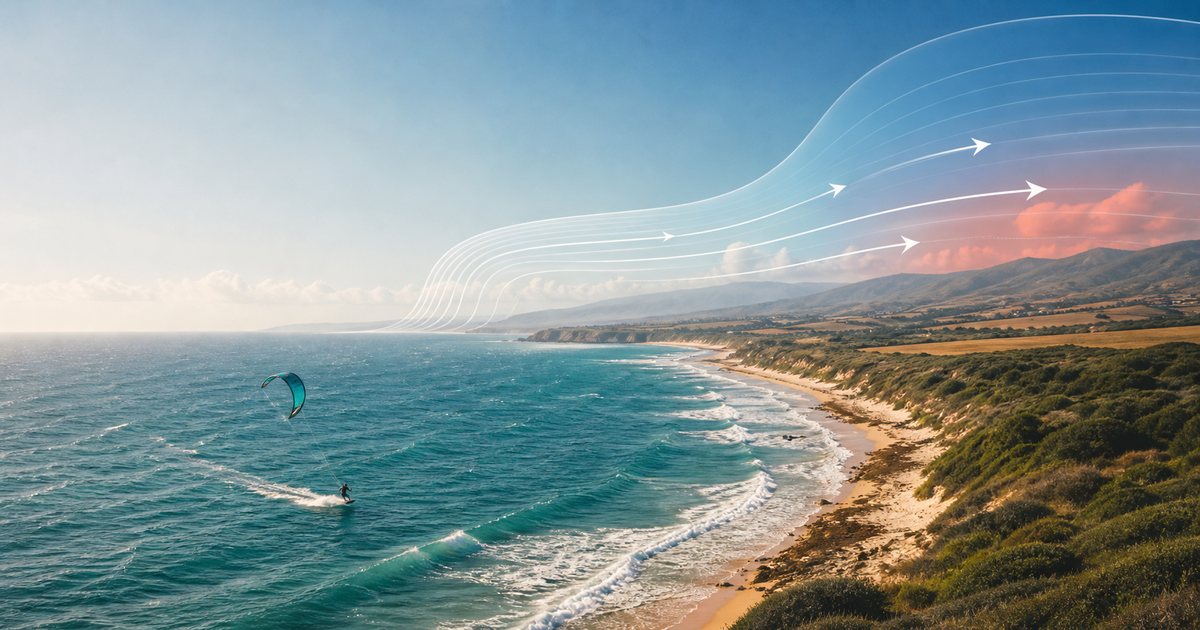
You check the forecast in the morning: 8 knots, barely sailable. You drive to the beach anyway, and by 14:00 the flag is snapping at 22 knots straight onshore. The forecast wasn’t broken — it just didn’t see the sea breeze.
If you ride coastal spots in spring or summer, this is the single most common reason your forecast lies to you. The good news is that sea breezes are some of the most predictable winds on the planet — if the model you’re using is fine enough to resolve them. Sea breeze is one of several types of wind that shape a session, and the most ridable of the daily ones.
What is a sea breeze?
A sea breeze is a wind driven by uneven heating between land and water. The sun heats land much faster than it heats the sea. By late morning the air over the coast is warmer, less dense, and rising. Cooler, denser air over the ocean flows in to take its place — and that horizontal flow, perpendicular to the coast, is the sea breeze.
At night the cycle reverses. Land cools faster than water, and a weaker offshore land breeze can develop — usually only a few knots and rarely useful for riding.
The daily thermal cycle
A textbook sea breeze day follows roughly the same arc, regardless of which coast you’re on:
| Time | What happens | Wind |
|---|---|---|
| Sunrise – 10:00 | Land warming, pressure gradient building | Light, often calm |
| 10:00 – 13:00 | Onset; wind backs/veers onshore | Building 8–14 kt |
| 13:00 – 17:00 | Peak; sea breeze front pushes inland | 15–25 kt |
| 17:00 – sunset | Decay as land cools | Weakens, direction softens |
| Night | Land cools below sea temperature | Light land breeze offshore |
Two details matter for riders. First, Coriolis veer: in the Northern Hemisphere the wind rotates clockwise through the day (right-handed), so a breeze that comes in due-onshore at noon is often 20–40° off-axis by late afternoon. Second, when there’s a synoptic gradient wind already blowing, the sea breeze either adds to it (parallel) or fights it (opposing). Stacked sea breeze + light gradient is what produces the famous “afternoon turbo” days at spots like Hyères or Tarifa.
Why GFS misses it
GFS — the US Global Forecast System — runs at roughly 13 km horizontal resolution. That sounds detailed until you realize a sea breeze front is often 1–5 km wide and the temperature contrast that drives it lives in the lowest few hundred meters of atmosphere.
GFS struggles because:
- Grid is too coarse — coastlines are smoothed, so the land/sea boundary is blurry
- Hydrostatic assumptions — vertical motions in the breeze front aren’t fully resolved
- Diluted contrast — averaging over a 13 km cell mixes land and sea pixels, killing the temperature gradient that drives the wind
- Onset timing is often hours late — or the breeze never appears at all
If your favorite app is GFS-only, you’ve probably noticed it consistently underforecasts afternoon wind on calm, sunny coastal days. That’s not a bug — it’s a resolution limit.
Why ICON and AROME nail it
Higher-resolution mesoscale models flip the picture. ICON, run by Germany’s DWD, operates at ~7 km globally and 2 km regionally over Europe (ICON-D2). AROME, run by Météo-France, goes even finer — about 1.3 km — and is non-hydrostatic and convection-allowing. Other regional models in the same class include HARMONIE (Scandinavia) and WRF (configurable, used widely by research and surf forecasters).
At those resolutions, the model can actually see the coastline as a sharp line, resolve the land/sea temperature step, and simulate the sea breeze front as a real feature — not as noise to be smoothed away. Onset timing typically lands within 30–60 minutes, and peak strength comes out within 2–4 knots of what actually happens.
Spotting a sea breeze day — checklist
Before you trust any forecast, ask yourself whether the ingredients are even on the menu:
- Synoptic gradient wind is light (under 10 kt) — strong gradient wind overrides thermal effects
- Clear skies forecast for the inland side — clouds kill the heating
- Spring or summer (roughly April–September in temperate latitudes)
- Inland air-temperature peak noticeably warmer than sea-surface temperature (a 3–5 °C contrast or more)
- Weak gradient / high pressure pattern with no fronts crossing
- The coastline orientation works for the prevailing thermal flow direction
If five of those six are true, expect a sea breeze. If three or fewer are true, the breeze probably won’t materialize.
Where sea breeze rules the season
A few well-known examples:
- Tarifa, Spain — most sessions are Levante or Poniente (gradient-driven), but the Atlantic side gets pure sea-breeze afternoons in midsummer when the gradient collapses.
- Hyères / Almanarre, France — classic AROME territory. On light-Mistral days the sea breeze stacks on the residual northerly to deliver clean 18–22 kt afternoons.
- Hel, Poland — calm Baltic high-pressure summer days produce sea breezes that ICON-EU regularly forecasts 6–10 kt stronger than GFS — and the higher number is usually the real one.
- Maui, Hawaii — the trade winds get a diurnal sea-breeze pulse in the afternoon. Global models flatten it; high-res models pick it up.
Frequently Asked Questions
Does sea breeze die at sunset?
Yes, almost always. Once direct solar heating stops, the inland temperature drops fast, the pressure gradient that drives the breeze collapses, and the wind fades within an hour or two of sunset.
Can sea breeze happen in winter?
Rarely in temperate latitudes — the sun isn’t strong enough to build the required temperature contrast. In the tropics and subtropics it can happen year-round.
Why does the wind shift right during the day?
In the Northern Hemisphere the Coriolis force deflects moving air to the right. As the breeze blows for hours, that deflection accumulates, so a noon onshore wind tends to swing several tens of degrees clockwise by mid-afternoon. Southern Hemisphere is the mirror image.
What is a sea breeze front?
The leading edge where cool marine air pushes inland against warmer continental air. You can sometimes see it as a line of cumulus clouds. As it passes, the wind suddenly increases and shifts onshore.
Does sea breeze work on lakes?
A “lake breeze” works on the same physics, but the temperature contrast is smaller, so the wind is usually lighter (5–12 kt) and the cycle is shorter. Big lakes like Garda or Erie still produce reliable thermal winds.
How Wavind helps
Most apps show one number from one model. Wavind shows GFS, ICON, and AROME side by side, so on a marginal sea-breeze day you can see when the high-resolution models predict 18 knots while GFS shows 8. When the models agree, confidence is high. When they disagree, the disagreement itself is a signal — and on coastal sea-breeze days, the high-res model is almost always closer to reality.
We go one step further: Wavind shows a sea breeze probability for each day, computed from the ingredients above (gradient wind, solar heating, land/sea temperature contrast, season, coastline orientation). Instead of guessing whether the conditions add up, you get a clear percentage that tells you how likely a thermal session actually is — so you can plan a half-day off work with confidence, not hope.
Put this into practice
Open the live wind, wave, and tide forecast for each spot in Wavind.
- Almanarre France Forecast
- Leucate Lagoon France Forecast
- El Balneario (Tarifa) Spain Forecast
- Pozo Izquierdo Spain Forecast
Browse more spots: France spots Spain spots