Tides for Surfers: When Low Tide Makes the Wave and When It Kills It
How tide shapes the wave on reef, point, and sandbar breaks, why some spots work only on a falling tide, and what spring and neap do to your session window.
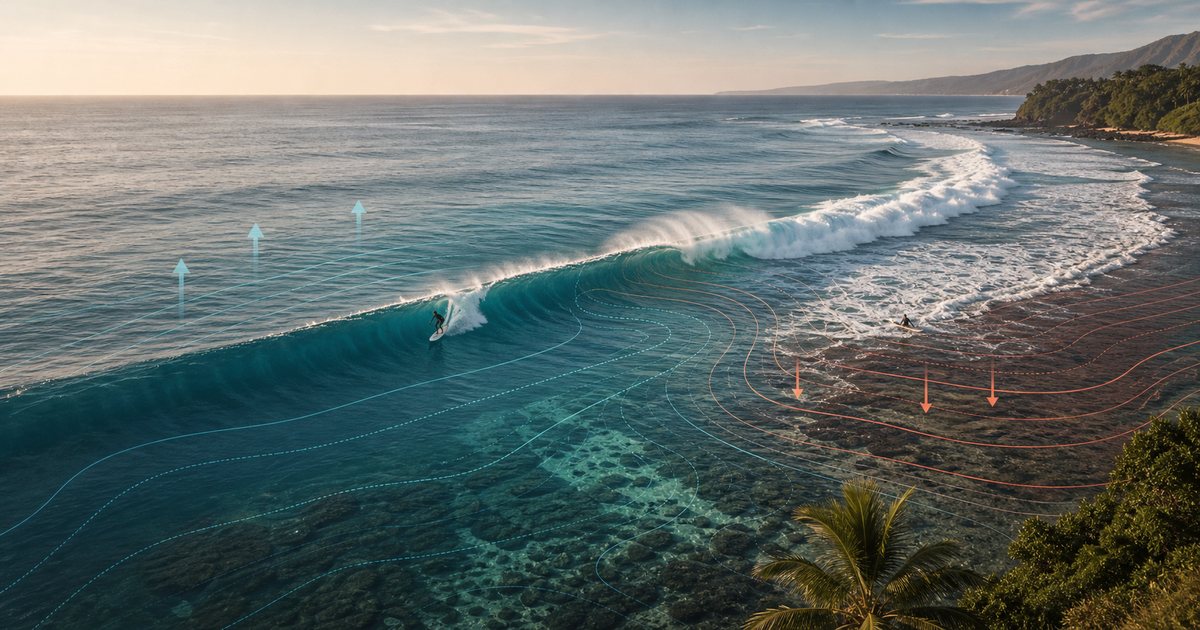
The forecast says head-high at 8 seconds, light offshore, 7:00 a.m. You drive an hour, paddle out, and the wave that broke clean an hour ago now folds over itself into a closeout. Same swell, same wind, different water level. The tide moved.
For a surfer, tide is not a footnote on the forecast — it is a third dimension stacked on top of swell and wind. The same swell on the same reef can be a peeling shoulder or an unrideable shore-dump depending on whether the bottom sits under one meter of water or three. Here is how the cycle works, why a wave reshapes itself across six hours, and which kinds of spot live or die on a specific phase.
If you already know the lunar mechanics from the kitesurfers’ guide, skim the next section — the physics is identical, but everything downstream changes.
What spring and neap tides are
Tides are the ocean responding to gravity from the moon and, to a smaller degree, the sun. As Earth rotates inside that stretched water envelope, most coasts pass through two highs and two lows in roughly 24 h 50 min — a semi-diurnal cycle.
At new moon and full moon, sun and moon line up and pull together. The result is spring tides — higher highs, lower lows, more vertical range. At first and last quarter they pull at right angles, partially cancel, and produce neap tides with a compressed range. A full cycle from one spring to the next is about 14.77 days, and the biggest springs of the year fall around the equinoxes in March and September.
For a surfer the takeaway is simple: spring tides move more water faster and expose more bottom; neaps move less and expose less. That difference rewrites the wave at most reef and sandbar spots.
How the tide shapes a wave
A wave breaks when its base feels bottom. The shallower the bottom under the breaking face, the steeper and faster the wave throws. That is why the same swell at the same spot looks different every two hours.
| Phase | Water over the bar/reef | What the wave does |
|---|---|---|
| High water | Deepest | Wave feels less bottom, breaks softer, often fat or mushy; on shallow reefs it can stop breaking entirely |
| Falling tide | Decreasing | Wave starts to feel bottom progressively earlier; faces steepen, lips thicken |
| Low water | Shallowest | Maximum throw; reefs can barrel hard, banks can close out from too much steepness |
| Rising tide | Increasing | Wave loses its bite; the line slows, sections reform farther inside |
The sweet spot depends on the depth where the swell first hits the contour. A reef sitting 2 m below the surface at low water might break perfectly on a 1 m drop and not break at all on a 2 m rise. The same spot at a different swell period needs a different tide because longer-period swell feels bottom from deeper water — a 14 s groundswell reacts to a contour an 8 s windswell rolls straight over.
Reef, point, sandbar — three different rules
The “best tide” question has no universal answer because three spot types react differently.
Reef breaks. Fixed bottom, often shallow. Wave shape depends almost entirely on depth above the reef.
- Too high — wave passes over without breaking, or breaks weakly
- Mid-low — cleanest, most makeable shape
- Dead low on a big spring — the wave throws over dry rock; you go home or get hurt
Point breaks. A long takeoff peeling along a headland. The point itself does not change, but tide controls how far out the wave starts to peel and how deep the inside runs.
- High — wave wraps further around the point, longer rides, softer face
- Low — the line starts shallower, the face is steeper, the inside can suck onto dry rock
Sandbar and beach breaks. The bottom is a moving target — sand reshapes after every storm. Tide interacts with whatever banks are there that week.
- A bar that produces an A-frame at mid-tide can close out at dead low and disappear at high
- Multiple banks at different depths mean the working peak migrates along the beach as water rises and falls
- A flat sand beach with no defined banks tends to dump at low and stay fat at high; mid is usually best
One heuristic if you remember nothing else: shallow spots peak somewhere on the dropping tide, deep spots peak somewhere on the rising tide, and “mid” is the safe default when you do not know your spot yet.
Wind, swell, and tide together
Tide does not act alone. Two interactions decide the surface texture as much as the wave shape.
- Wind against tide. The effect we covered for kiters applies in the lineup. When a tidal current runs against the wind — common in estuaries, between islands, on coasts with strong long-shore drift — the wave face goes short and chattery, the takeoff feels nervous, and a downed surfer can drift fast. Wind with tide cleans the same swell up. Spring ebbs amplify both extremes; neaps soften them.
- Currents in the lineup. A 2–3 m spring drop moves a lot of water through a single channel. On a peak with a defined rip, the rip strengthens through mid-ebb — useful for paddling out, dangerous for a held-down surfer.
- Swell period and depth. A 14 s groundswell starts to react to the tide an hour earlier than an 8 s windswell on the same reef. Long-period south swells at California’s points wall up well before the bar is shallow; short-period windswells need it properly low to do anything.
Reading your spot — checklist
Before you commit to the drive, run the tide check:
- What is the tidal range on this date — spring, neap, or in between?
- When do high and low water fall, and is your swell/wind window on a rising or falling tide?
- Does the spot need a minimum depth to work, or a maximum depth above which it stops?
- Is the bottom fixed (reef, point) or moving (sand)?
- Will the tidal current run with or against the wind in the lineup?
- For sea-breeze afternoons (see Sea Breeze 101) — does the breeze peak with rising or falling water?
If five of those six lean the right way, drive. If three or fewer do, the conditions on paper are probably not the conditions in the water.
Where tide rules the wave
A few spots where tide is the lead actor, not the supporting one:
- Mundaka, Spain — a sandbar at a river mouth. Works best on a draining tide when river outflow and ebb pull water across the bar. High water and the wave loses its line; the wrong tide on a perfect swell day is one of surfing’s classic heartbreakers.
- Thurso East, Scotland — a slab reef in the Pentland Firth. Wants a low-to-mid tide pushing in; too high and it does not break, too low and the slab gets dangerous. Pentland currents add wind-against-tide chop on the wrong wind.
- Hossegor, France — beach breaks over shifting sand. Range of 3–4 m and constant bar reshaping mean the working peak moves both along the beach and through the cycle. Locals time the morning session to the dropping tide.
- Rincon, California — a cobblestone point. Long peeling rights wrap further around on a higher tide; mid-incoming on a clean north or west groundswell is the textbook answer.
- Bundoran (The Peak), Ireland — a sucky reef. Needs enough water over the takeoff rock to be makeable; too low and it lurches over dry stone. Mid-incoming on a clean Atlantic groundswell.
- Snapper Rocks, Australia — sand-bottom point. Range under 2 m, but the sandbank itself is fragile; tide moves the takeoff zone by 20–30 m, which on a crowded lineup is the difference between paddling into the right spot and watching the set roll past.
Frequently Asked Questions
What is the best tide for surfing?
It depends on the spot. Shallow reefs and slabs generally peak somewhere on a dropping tide; deep points and beach breaks usually want a rising or mid tide. Mid-tide is the safe default for an unknown spot, but the right answer for your spot is a one-line note you should keep next to its name.
Why does the same wave change so much with the tide?
Because wave shape is set by depth at the breaking point, not by swell size. A 1.5 m wave feels bottom at roughly 3 m depth; if that contour sits over rock at low and over sand at high, the same swell breaks at two different places with two different shapes.
Does swell direction interact with tide?
Yes. A swell that hits a reef at a steep angle starts to feel bottom earlier and over a wider depth range than one that hits straight on, so the spot’s tide window shifts with direction. A south swell and a west swell on the same reef rarely want the exact same tide.
Do tides matter for Mediterranean surfing?
Far less than in the Atlantic or Pacific. Most of the Med has 20–40 cm of range, which barely changes the wave at most spots. The exceptions are the northern Adriatic and the Gulf of Gabès, where tide can matter on the few rideable days.
Is wind-against-tide dangerous for a surfer?
More uncomfortable than dangerous in the lineup, but it matters when you fall. A mid-ebb current on a spring can move a held-down surfer 50–100 m before they surface, and a contrary wind makes paddling back harder than the wave size would suggest. On exposed points and inlets, plan your paddle-out line around the current, not just the channel.
How do I find tide data for my spot?
National hydrographic offices publish free tide tables — SHOM in France, UKHO in the UK, NOAA in the US, IH in Portugal, BSH in Germany. Surf and marine apps overlay a tide curve on the nearest reference port. For unfamiliar spots, ask locals which phase the spot prefers — tables tell you when, locals tell you why.
How Wavind helps
Swell, wind, and tide are three forecasts that have to agree before the session does. Wavind shows the tide curve next to the multi-model wind view, so you read GFS, ICON, and AROME against a rising or falling water level — and the offshore/onshore wind window stops being judged in isolation from the wave you actually plan to ride.
You can also tell each spot which tide it works on. Per-spot acceptable tide ranges feed into the session score, so a forecast that is perfect on paper but lands on a dead-low spring at your reef quietly drops out of the green. Your spot, your rules, scored against every hour of the cycle.
Want sessions scored against tide, swell, and wind together? Start free with Wavind.
Put this into practice
Open the live wind, wave, and tide forecast for each spot in Wavind.
- Supertubos (Peniche) Portugal Forecast
- Reef (Ericeira) Portugal Forecast
- Les Culs Nuls (Hossegor) France Forecast
- Jeffreys Bay South Africa Forecast
Browse more spots: Portugal spots France spots